







BlackRock’s Bitcoin ETF Records Longest Outflow Streak Since Launch
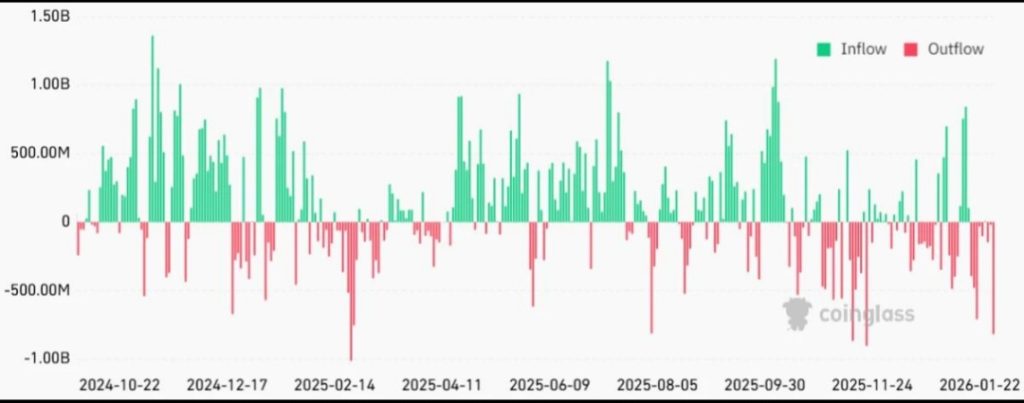
BlackRock’s spot Bitcoin exchange-traded fund (ETF), the iShares Bitcoin Trust (IBIT), has entered its longest period of sustained withdrawals since launching, with investors pulling 35,980 BTC—worth approximately $2.24 billion—over 10 consecutive trading days. The latest figures have raised fresh questions about institutional sentiment toward Bitcoin following months of strong ETF-driven demand.
The outflow streak comes after IBIT established itself as the dominant player among U.S. spot Bitcoin ETFs, attracting tens of billions of dollars in assets since its debut. Although the recent withdrawals are significant, BlackRock continues to manage one of the largest Bitcoin investment products globally.
A Historic Redemption Streak
According to recent market data, BlackRock’s ETF has experienced net redemptions for ten straight trading sessions, resulting in nearly 36,000 BTC leaving the fund. Based on current market prices, those withdrawals are valued at roughly $2.24 billion.
This marks the longest continuous outflow period in the fund’s history.
During ETF redemptions, authorized participants redeem ETF shares in exchange for the underlying Bitcoin, effectively reducing the fund’s holdings. While ETF inflows are generally viewed as bullish because they require additional Bitcoin purchases, sustained outflows can increase selling pressure or reflect reduced institutional demand.
Why Investors Are Pulling Money Out
Several factors may be contributing to the recent withdrawals.
Bitcoin has experienced increased volatility in recent months, prompting some institutional investors to reduce exposure after significant gains during previous market cycles. Higher interest rates and broader macroeconomic uncertainty have also encouraged investors to rotate capital into traditional financial assets that generate yield. Profit-taking may also be playing a role, as some institutions choose to lock in gains after Bitcoin’s strong long-term performance.
Importantly, ETF outflows do not necessarily indicate that investors have turned bearish on Bitcoin permanently. Portfolio rebalancing, risk management, and changing investment mandates can all contribute to temporary redemption activity.
BlackRock Still Dominates the ETF Market
Despite the recent withdrawals, IBIT remains the largest spot Bitcoin ETF by assets under management.
Since launching, the fund has accumulated tens of billions of dollars in net assets and holds a substantial amount of Bitcoin on behalf of investors. Even after the recent redemption streak, BlackRock continues to be one of the most influential institutional participants in the Bitcoin market.
Its scale means that any sustained inflow or outflow trend is closely monitored by traders because ETF activity can influence overall market liquidity and investor sentiment.
Market Reaction Remains Mixed
Interestingly, Bitcoin’s price has not experienced a collapse despite the large ETF withdrawals. Many analysts believe that long-term holders, corporate buyers, and other institutional investors continue to absorb available supply, helping stabilize the market even as ETF demand weakens.
Market participants are now watching closely to determine whether the current redemption streak represents a short-term correction or the beginning of a broader shift in institutional positioning. Some analysts argue that ETF flows tend to lag broader market sentiment rather than lead it, meaning inflows could eventually return if Bitcoin resumes a stronger upward trend.
Institutional Demand Still Matters
Since the approval of spot Bitcoin ETFs, institutional investment has become one of the biggest drivers of Bitcoin demand.
Large asset managers such as BlackRock, Fidelity, and other ETF issuers collectively hold hundreds of thousands of Bitcoin on behalf of investors. Their buying activity has significantly reduced the amount of Bitcoin available on exchanges over the past two years.
Consequently, prolonged ETF outflows can temporarily weaken demand, while renewed inflows often strengthen bullish momentum.
Because Bitcoin has a fixed supply of 21 million coins, sustained institutional buying remains one of the most closely watched indicators for long-term price performance.
What Investors Should Watch Next
The next few trading sessions could prove important.
If BlackRock’s IBIT begins recording fresh inflows, many investors may interpret it as renewed institutional confidence.
However, if withdrawals continue beyond the current streak, analysts will likely examine whether broader economic conditions, interest-rate expectations, or changing investor risk appetite are driving the trend.
Regardless of near-term fluctuations, BlackRock’s ETF remains one of the largest gateways for institutional Bitcoin exposure and continues to play a major role in shaping overall market sentiment.
Why It Matters
BlackRock’s 10-day outflow streak highlights that institutional demand for Bitcoin can fluctuate even after record ETF adoption. Because IBIT is the world’s largest spot Bitcoin ETF, its fund flows are closely watched as a barometer of institutional confidence and can influence broader market sentiment.
Key Takeaways
•BlackRock’s iShares Bitcoin Trust (IBIT) has recorded 10 consecutive trading days of net Bitcoin outflows.
•Approximately 35,980 BTC, valued at around $2.24 billion, has left the ETF during the streak.
•The streak represents the longest outflow period since IBIT launched.
•Despite the withdrawals, BlackRock remains the world’s largest spot Bitcoin ETF issuer by assets under management.
Analysts are watching whether institutional demand rebounds or if the outflows continue in the coming weeks.
