






Switzerland’s financial regulator has approved the country’s first spot Bitcoin ETF for retail investors, with a SIX listing expected in November.
Key Takeaways
- Switzerland’s regulator FINMA approved the first spot Bitcoin ETF open to retail investors on October 20.
- The fund, Bitcoin Fund ETF (BBIT), comes from Zurich-based BIT Asset Management, a subsidiary of Singapore-headquartered BIT, formerly Matrixport.
- It is expected to begin trading on SIX Swiss Exchange in November, but no exact date or fee has been published.
- The US ordered DeepSeek removed from federal civilian agency IT systems over data-exposure fears.
- Swiss President Guy Parmelin proposed linking Crypto Valley with Vietnam’s innovation ecosystem.
A First for Swiss Retail Investors
Switzerland has approved its first spot Bitcoin ETF for retail investors, and the Swiss Bitcoin ETF is backed by a Singapore-based group. On October 20, Swiss regulator FINMA approved the Bitcoin Fund ETF, ticker BBIT, according to BIT Asset Management’s announcement. The fund is expected to start trading on SIX Swiss Exchange in November. Cointelegraph’s Asia Express column picked up the story alongside two other Asia-linked headlines this week.
BIT Asset Management is a Zurich-based, FINMA-regulated manager owned by BIT, which was known as Matrixport until its rebrand. The firm’s CEO, Dominik Oggenfuss, said investors can now reach Bitcoin through an ordinary Swiss bank account, with Swiss fund governance, independent custody and daily transparency on holdings.
How the Swiss Bitcoin ETF Differs From Existing Products
Swiss investors have long been able to buy Bitcoin exposure through exchange-traded products, which trade on SIX but don’t have fund status. The Block noted that the new ETF falls under a different regulatory framework for investment funds. FINMA had also authorized a crypto fund in 2021, but that one was limited to qualified investors, according to BeInCrypto.
BBIT is a Swiss collective investment scheme that holds Bitcoin directly, and its assets are ring-fenced from the manager, according to GN Crypto. BeInCrypto reported that FINMA waived its own diversification rules to clear the product, while warning that Bitcoin remains highly risky. The regulator also said other providers have already filed or announced Bitcoin ETF applications.
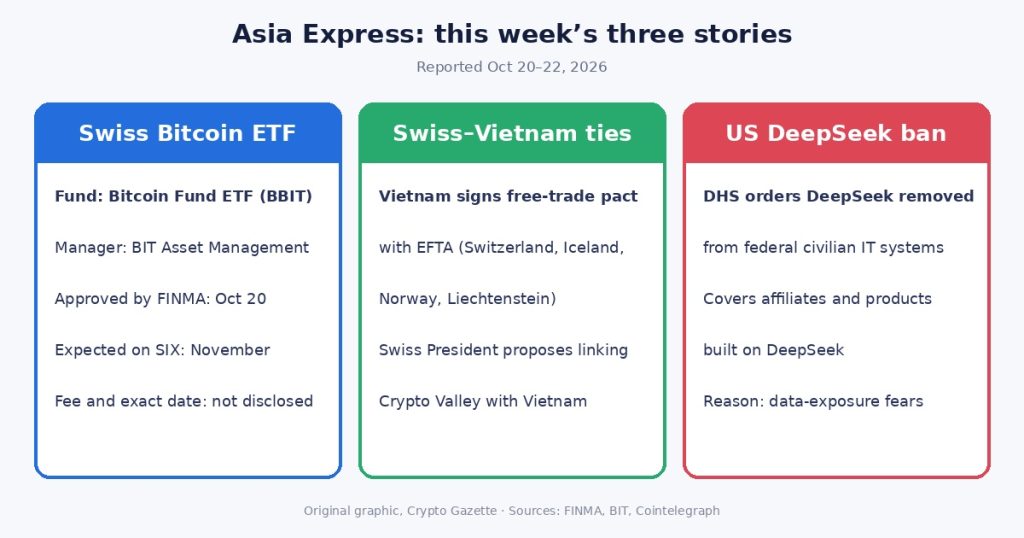
This week’s Asia Express stories: a Swiss Bitcoin ETF, Swiss–Vietnam crypto ties and a US DeepSeek ban.
“Europe’s Only Spot Bitcoin ETF”?
BIT describes BBIT as Europe’s only spot Bitcoin ETF, and Cointelegraph repeated that framing. One report notes the more precise claim is that it is the only one structured as a collective investment scheme. That matters because Europe already has many spot-backed Bitcoin exchange-traded products. Readers should treat the “only” label as the issuer’s marketing language tied to a specific legal structure.
Switzerland and Vietnam
In the same column, Cointelegraph reported that Vietnam has signed a free-trade agreement with the European Free Trade Association, which covers Switzerland, Iceland, Norway and Liechtenstein. After meeting Vietnam’s prime minister, Swiss President Guy Parmelin proposed linking Switzerland’s Crypto Valley hub with Vietnam’s innovation ecosystem. The areas named were blockchain, AI and quantum technology. It is a proposal, not a signed crypto agreement.
The DeepSeek Ban
On the AI side, the US Department of Homeland Security ordered DeepSeek products removed from federal civilian agency IT systems. Cointelegraph reported that the order also covers DeepSeek affiliates and third-party products built using its implementations, and bars new purchases. DHS warned that use by government employees and contractors could expose sensitive information to China. Reports differ on the exact date the order was signed.
Why It Matters for Crypto
The Swiss ETF is the most relevant item for markets. It broadens regulated retail access to Bitcoin in one of Europe’s key financial centers, and it adds a fund wrapper that many banks and advisers are more comfortable offering. How much demand it draws will depend on fees, distribution partners and listing details, none of which have been disclosed.
For context, U.S. spot Bitcoin ETFs saw $528 million in inflows in a day and $1.08 billion over three sessions, according to reporting by Atlabyte. Bitcoin traded near $82,000 this week. The Swiss approval has no reported price impact so far, and there are no specific support or resistance levels tied to it. The DeepSeek ban is mainly an AI and national-security story, and no direct crypto market effect has been reported.
Risks and What to Watch
BBIT has not started trading, and the fee, custodian and retail distribution partner have not been disclosed, per BeInCrypto and CoinStats. Bitcoin’s volatility remains the main risk for any investor. Watch for the exact SIX listing date, other Swiss applications, any follow-up on the Vietnam proposal and further US restrictions on Chinese AI products.
Conclusion
Switzerland’s first retail spot Bitcoin ETF is a notable regulatory step, but it is still a plan until trading starts in November. The Swiss–Vietnam proposal and the DeepSeek ban round out a week of Asia-linked headlines with limited direct market impact. The next real signal will be BBIT’s launch details and whether other issuers follow. This article is not financial advice.
