






Fidelity-linked cryptocurrency holdings have reportedly increased by millions of dollars across Bitcoin, Ethereum and Solana over the past 20 trading days, according to figures attributed to blockchain analytics platform Arkham Intelligence. The figures shared in a recent social media post put the reported increases at $354.1 million in Bitcoin (BTC), $66.6 million in Ethereum (ETH) and $18.2 million in Solana (SOL).
Together, the three figures amount to approximately $438.9 million. The reported change has drawn attention to Fidelity’s role in the digital asset market and the growing use of blockchain analytics to monitor cryptocurrency wallets associated with major financial institutions.
However, an important distinction matters for investors: changes in the value or balances of wallets labelled as Fidelity-related do not automatically establish that Fidelity itself purchased all the assets during that period. The screenshot attributes the figures to Arkham, but the exact 20-day calculation could not be independently confirmed from an accessible primary source during this research. The numbers should therefore be described as reported on-chain data, not as confirmed direct purchases by Fidelity.
Bitcoin Accounts for the Largest Reported Increase

Bitcoin represents the largest portion of the reported change, with $354.1 million attributed to the increase in Fidelity-linked BTC holdings. Ethereum follows at $66.6 million, while Solana accounts for $18.2 million.
The difference is notable because Bitcoin alone represents the majority of the combined $438.9 million figure. The reported data also spans three different crypto assets, suggesting that the monitored portfolio includes exposure beyond Bitcoin.
For market watchers, the figures offer a reason to examine institutional crypto activity more closely. Large financial firms can participate in the digital asset market through investment products, custody arrangements and other services, and on-chain tracking can provide clues about how assets move through the blockchain ecosystem.
Nevertheless, wallet data requires context. A transfer between custody addresses, a change in the market price of an asset, or the movement of customer funds can affect the value displayed on a tracking platform without necessarily representing a new investment decision.
What the Arkham Data Actually Show
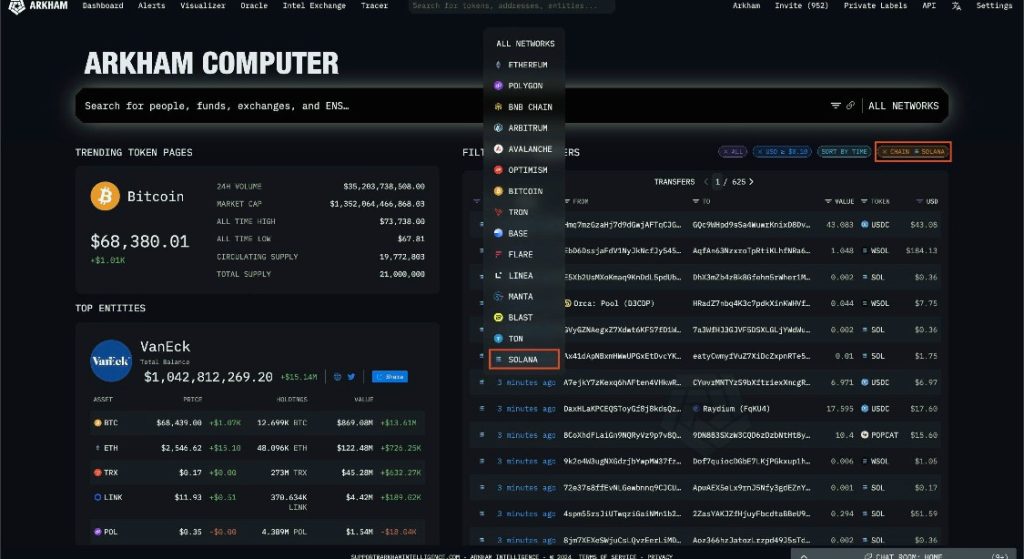
Arkham Intelligence tracks cryptocurrency addresses and groups addresses into entities that it believes are associated with particular organizations or individuals. Its data can help analysts examine wallet balances, trace transactions and monitor changes in on-chain holdings. Arkham also explains that entity-level figures are based on addresses it has identified and attributed to those entities.
That makes blockchain analytics useful, but it does not make every portfolio change proof of a purchase. An increase in a wallet’s dollar value can happen because the asset price rises, because more tokens arrive, or because addresses are newly attributed to an entity. Transfers between wallets can also change the way holdings appear on a dashboard.
There is a further complication when a financial institution acts as a custodian for customers. Assets held by a custodian do not necessarily belong to the custodian itself. Arkham’s own research notes this distinction when discussing Fidelity Custody and Bitcoin held on behalf of Strategy.
For that reason, the most accurate interpretation of the screenshot is that it reports a change in assets tracked under Fidelity-related labels. Without a verified breakdown of token quantities, wallet movements and the calculation method, it would be premature to say that Fidelity directly spent $438.9 million buying the three cryptocurrencies.
Why Institutional Crypto Activity Matters
Institutional participation is an important part of the cryptocurrency market because large financial firms can provide investment access, custody services and infrastructure for clients seeking exposure to digital assets. Their activity is closely watched by traders who want to understand whether demand from larger market participants is growing or weakening.
Fidelity is a major financial services company with digital asset-related offerings, while Arkham provides tools that help users inspect blockchain activity. When data attributed to a major financial institution begins circulating online, investors often look for signs of accumulation, portfolio changes or wider shifts in institutional interest.
Still, on-chain movements alone do not reveal the full investment strategy behind a portfolio. A reliable conclusion requires checking the source of the funds, the ownership of the wallets and whether the reported change reflects purchases, transfers, custody operations or price movements.
What Investors Should Watch Next
The next step is to see whether the reported figures can be confirmed through Arkham’s original post or a detailed view of the relevant entity and wallet records. Investors should also watch for any explanation of whether the numbers refer to changes in token quantities, dollar valuations or both.
If the figures reflect genuine net inflows of BTC, ETH and SOL into investment vehicles or wallets linked to Fidelity’s products, they could provide useful evidence of demand during the period. If they primarily reflect custody movements or valuation changes, the market implications would be different.
Neither interpretation should be assumed without further evidence. The distinction matters because traders can mistake transfers or changes in portfolio value for fresh buying and draw stronger conclusions than the data supports.
Conclusion
The figures circulating from Arkham suggest that Fidelity-linked crypto holdings increased by $354.1 million in Bitcoin, $66.6 million in Ethereum and $18.2 million in Solana over 20 trading days, a combined reported change of $438.9 million. Bitcoin accounts for the largest share of the total, drawing attention to the scale of BTC exposure tracked under Fidelity-related labels.
However, the figures should not be treated as confirmed direct purchases by Fidelity without further verification. Blockchain analytics can reveal important information about asset movements, but wallet attribution, custody arrangements and changes in market prices must be considered before drawing conclusions about institutional investment demand.
For Crypto Gazette readers, the key takeaway is to follow the underlying data rather than the headline alone. Confirmation of the original Arkham figures and their methodology would help establish whether the reported increase reflects fresh accumulation, custody activity or a change in the dollar value of existing holdings.
