





Ripple and Meritz Securities will explore digital asset custody and tokenization for South Korea’s capital markets.
Key Takeaways
• Ripple and Meritz Securities signed a strategic partnership on October 1 and announced it on October 7. The two firms will explore custody and tokenization for Korean capital markets.
• It is Ripple’s fourth institutional partnership in South Korea in 2026, following Kbank, Kyobo Life and Jeonbuk Bank.
• The work starts within current securities rules, and the scope will widen as Korean regulation develops.
• No product launch, timeline or XRP commitment has been announced.
• XRP fell about 4% on announcement day amid a wider crypto pullback.
A Fourth Korean Deal for Ripple
Ripple has signed a strategic partnership with Meritz Securities, one of South Korea’s established brokerages. The two firms will study how Ripple’s institutional custody product, Ripple Custody, and its tokenization infrastructure could be applied to Korean capital markets. According to reports, the agreement was signed on October 1 at Meritz’s headquarters in Yeouido, Seoul, by Meritz CEO Jang Won-jae and Ripple President Monica Long. Meritz publicly disclosed it on October 7.
For Ripple, this is the fourth Korean institutional tie-up of 2026. CoinDesk reported in August that Jeonbuk Bank had become Ripple’s third Korean partner of the year, after custody and wallet infrastructure deals with Kyobo Life Insurance and Kbank. Meritz moves that push from banks and insurers deeper into securities.
What the Partnership Covers
This is an exploratory agreement, not a launch. The firms will jointly examine how Ripple’s tokenization tools and Ripple Custody could work in Korea, starting within existing securities and digital asset rules. Meritz said it would prepare services in stages as the domestic regulatory environment evolves.
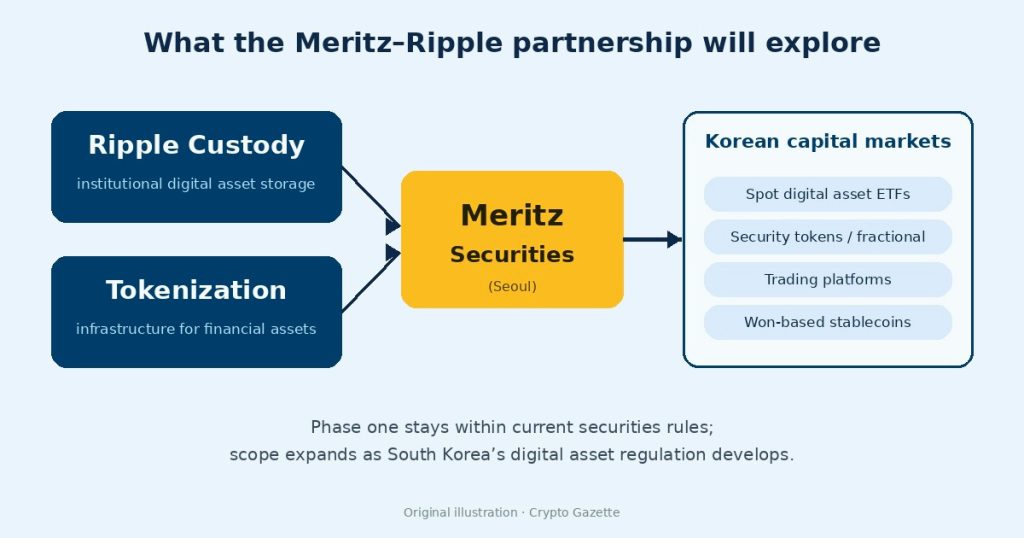
Meritz is also reviewing a wider set of businesses as digital assets move toward the regulated system. These include spot digital asset ETFs, fractional investment and security tokens, trading platforms and won-denominated stablecoins. Custody and tokenization sit underneath most of that list, which helps explain why they are the first items on the table.
Ripple’s Asia-Pacific managing director, Fiona Murray, said the company looks forward to exploring how digital asset infrastructure can support the development of Korea’s capital markets. A Meritz official said the deal lays the groundwork for combining Ripple’s global infrastructure with the brokerage’s capital markets capabilities.
Why the Ripple Meritz Partnership Matters
The timing lines up with Korean regulation. According to DailyCoin, amendments covering tokenized securities are scheduled to take effect on February 4, 2027. A brokerage that has already studied custody and tokenization partners will be better placed when those rules arrive, though neither company has said what it plans to launch.
Ripple’s global push into custody is also visible elsewhere. Reports say South African lender Absa launched digital asset custody built on Ripple’s technology in September. For Ripple, a steady run of regulated partners suggests the company is building its business around infrastructure for institutions, with the XRP token only one part of the story.
What It Means for XRP
Here the picture is less clear. Ripple’s custody and tokenization products can be used without a customer holding XRP, and Meritz has not said whether XRP, Ripple’s RLUSD stablecoin or the XRP Ledger would be involved in any future offering. The agreement does not include an XRP purchase commitment.
The market reaction reflected that. Benzinga reported that XRP fell about 4% on announcement day alongside a broader crypto sell-off. Another outlet put XRP near $1.40 on October 9. Benzinga also noted that XRP was still trading above its 50-day, 100-day and 200-day moving averages, which keeps the broader trend technically intact for now.
Some analysts remain bullish on the longer term. One widely shared call outlines a path to $50 in a Bitcoin bull run, a scenario that would need XRP to multiply roughly 34 times and that CCN notes rests on a repeat of 2017. That is a forecast rather than a reported fact.
Risks and What to Watch
There are several reasons for caution. The partnership is a study, and Meritz has said it will stay within current securities permissions, so any real product depends on regulators. Earlier Ripple deals in Korea have also done little for the token price, as CoinDesk noted in August when XRP slipped below $1. The broader market remains a swing factor too.
Traders will likely watch whether Ripple and Meritz name a pilot or launch, whether any product ties into XRP or RLUSD, and how the Korean tokenization rules shape up before February. Without clear XRP demand from these deals, the price may keep following Bitcoin and overall crypto sentiment.
Conclusion
Ripple’s tie-up with Meritz Securities adds another regulated Korean name to its institutional roster and puts the company on the securities side of the market. For now it is an agreement to explore, not a product, and it does not say how or whether XRP will be used. That leaves traders waiting for concrete announcements, and the next real test will be what Korean regulators allow in 2027. This article is not financial advice.