






Key Takeaways
- The CFTC’s crypto rulemaking entered White House review on September 17, according to the federal regulatory database.
- The action, RIN 3038-AF80, is titled “Regulation Crypto Asset Transactions and Regulation Crypto Asset Markets.”
- The filing remains at the prerule stage, meaning the public record does not yet contain a proposed regulatory text or final requirements.
- The move comes days after the Senate failed to advance the Digital Asset Market CLARITY Act in a 49-50 cloture vote.
- Bitcoin subsequently climbed above $85,000, while U.S. spot Bitcoin ETFs recorded $324.6 million of net inflows on September 18, according to Farside Investors.
Introduction
U.S. crypto regulation is moving along two tracks at once.
Congress has yet to advance a comprehensive market-structure bill, but federal regulators are continuing to develop rules under their existing authorities. The latest development is a Commodity Futures Trading Commission action covering crypto-asset transactions and markets that has entered review by the White House’s Office of Information and Regulatory Affairs.
The significance is not that a new crypto rule has already been adopted. It has not. The important development is that the CFTC has moved a broad crypto regulatory initiative into the federal review pipeline, creating another potential route for market-structure rules while legislation remains unresolved.
For crypto exchanges, derivatives venues, institutional investors and other market participants, the next question is therefore less about what the CFTC has already changed and more about what eventually emerges from the process.
What Happened?
The federal regulatory database lists a CFTC action under RIN 3038-AF80, titled “Regulation Crypto Asset Transactions and Regulation Crypto Asset Markets.”
The submission was received by the Office of Information and Regulatory Affairs on September 17, 2026, and is listed as “Prerule” with its status marked “Pending Review.”
That distinction matters. A prerule is an early point in the regulatory process. The public filing does not provide the detailed regulatory text needed to determine precisely which assets, platforms, transactions or business models would ultimately be affected.
The development follows the Senate’s September 15 vote on the Digital Asset Market CLARITY Act. The Senate rejected cloture on the motion to proceed to H.R. 3633 by 49 votes to 50, according to the Senate’s official record.
The CFTC had already signaled that it was developing crypto-market initiatives using its existing statutory authority. Chairman Michael S. Selig has previously discussed work involving crypto-asset market structure, tokenized collateral and other digital-asset market infrastructure.


The Commodity Futures Trading Commission’s headquarters in Washington, D.C.
The Key Details
The federal filing provides three particularly important pieces of information.
First, the initiative is broad in name. It covers both “Crypto Asset Transactions” and “Crypto Asset Markets.” That wording indicates a market-wide regulatory project, although the filing itself does not establish the scope of any eventual rules.
Second, the action is currently classified as a prerule, rather than a proposed rule or final rule. Investors and companies therefore should not interpret the filing as a new compliance obligation.
Third, the action is being reviewed by OIRA, the regulatory-review office within the Office of Management and Budget. The review is one stage in the federal rulemaking process; it does not mean that the CFTC’s eventual policy has been approved or finalized.
The development also fits into a broader 2026 regulatory push. The CFTC and Securities and Exchange Commission have separately pursued efforts to clarify federal oversight of digital assets, while the SEC recently created temporary, conditional exemptions for certain venues trading tokenized National Market System stocks.
Why It Matters
The immediate importance is regulatory optionality.
If Congress eventually enacts comprehensive market-structure legislation, the statutory framework could determine how federal agencies divide responsibilities across the digital-asset market. If legislation remains stalled, agency rulemaking becomes an increasingly important part of the regulatory picture.
That does not mean agency rules can simply replace legislation in every respect. Agencies remain constrained by the statutes Congress has already enacted, and significant rules must proceed through the applicable administrative process.
For exchanges and market infrastructure providers, however, even an early-stage CFTC initiative can matter because businesses often begin compliance planning well before a regulation becomes final.
The uncertainty is therefore concentrated around the eventual contents of the rulemaking. Until those details become public, claims about specific tokens, exchanges or trading products being included would go beyond the available evidence.
Market Reaction
The regulatory development arrived during a broader rebound in crypto markets.
Bitcoin rose above $85,000 on September 21, reaching an intraday high of roughly $85,166 according to market reports. The move extended a recovery that had already pushed Bitcoin above $80,000 late the previous week.
ETF flows provide another piece of context. Farside Investors recorded $324.6 million in net inflows into U.S. spot Bitcoin ETFs on September 18, with Fidelity’s FBTC accounting for $310.7 million. The previous two trading sessions had recorded combined net outflows of more than $746 million.
Ethereum ETFs also returned to positive territory on September 18, posting $29.4 million in net inflows after three consecutive sessions of withdrawals.
The market response should not be attributed to the CFTC filing alone. Bitcoin’s move occurred alongside broader changes in risk sentiment, ETF demand and other regulatory developments. The timing makes the rulemaking relevant context, but it does not establish a single cause for the price move.
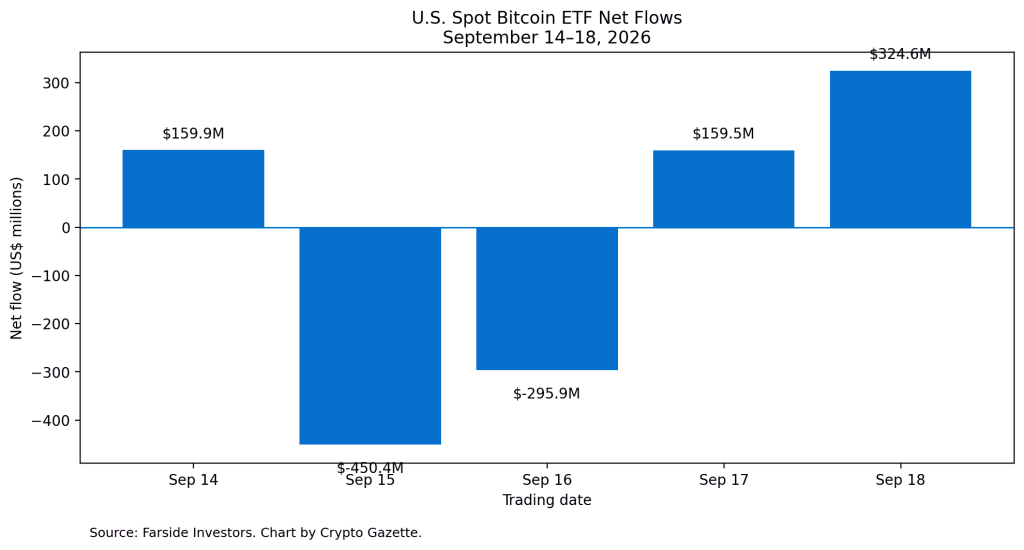
U.S. spot Bitcoin ETF net flows swung sharply during the week of September 14–18, including $324.6 million of net inflows on September 18.
What Happens Next?
The CFTC initiative remains at an early stage.
The immediate milestone is the completion of White House regulatory review. Beyond that, the precise procedural path will depend on the agency’s subsequent actions and the contents of any eventual proposal.
For the crypto industry, the most important document will be the first public version that explains what the CFTC intends to regulate, which statutory authorities it plans to rely upon and how the framework would interact with existing securities and commodities rules.
Until that information is available, market participants have more evidence that rulemaking is being pursued than they have evidence about the final substance of the rules.
Crypto Gazette Analysis
The most useful way to read the filing is as a process story, not a policy verdict.
The Senate’s CLARITY Act vote demonstrated that comprehensive legislation remains unresolved. The CFTC filing demonstrates that the regulatory agencies are not necessarily waiting for Congress before continuing work within their existing authorities.
That creates a more complicated regulatory landscape. Instead of one single event determining the next phase of U.S. crypto rules, legislation, SEC rulemaking, CFTC rulemaking and agency interpretations can all develop in parallel.
For exchanges and institutions, that makes the eventual boundaries between securities regulation, commodities regulation and digital-asset market infrastructure particularly important.
It also explains why the current filing should not be overinterpreted. The public record tells us that a broad CFTC crypto-market initiative has reached White House review. It does not yet tell us the final rules.
That distinction is likely to become increasingly important as crypto markets react to regulatory headlines before the underlying legal text is available.
Conclusion
The CFTC has taken another procedural step toward developing rules for crypto-asset transactions and markets, with its RIN 3038-AF80 action now listed as pending White House review.
The move comes after the Senate failed to advance the CLARITY Act and as U.S. regulators continue working on digital-asset policy through existing authorities.
For now, the headline is the regulatory process itself. The substance remains to be disclosed.
Sources
- U.S. Office of Information and Regulatory Affairs — CFTC RIN 3038-AF80, “Regulation Crypto Asset Transactions and Regulation Crypto Asset Markets.”
- U.S. Senate — September 15, 2026 roll-call vote on H.R. 3633.
- Commodity Futures Trading Commission — Chairman Michael S. Selig statements and crypto-market initiatives.
- Farside Investors — U.S. Bitcoin and Ethereum ETF flow data.
- U.S. Securities and Exchange Commission — Innovation Exemption for tokenized NMS stocks.
