





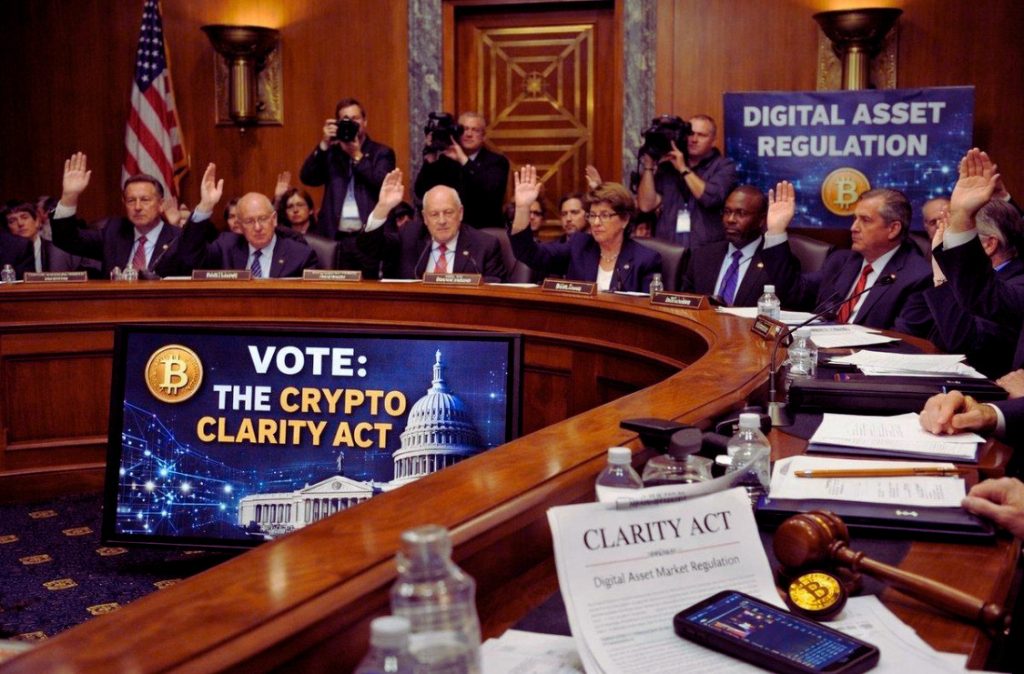
The cryptocurrency market has recovered more than $200 billion in total value since the sharp sell-off that followed the U.S. Senate’s failure to advance the CLARITY Act, with Bitcoin returning above $80,000 as broader digital-asset prices moved higher. The rebound came only days after lawmakers rejected a procedural motion to move the legislation forward, highlighting how quickly market attention shifted from the congressional setback to developments involving regulators, monetary policy and tokenized assets.
The Senate vote took place on September 15. The motion to invoke cloture on the motion to proceed to H.R. 3633 received 49 votes in favor and 50 against, falling short of the 60 votes required. The Senate’s official record confirms that the motion was rejected. Senator Thom Tillis subsequently entered a motion to reconsider, so describing the CLARITY Act as permanently dead would go beyond what the official record establishes. The legislation is designed to establish a federal framework for digital assets, including rules around the respective roles of the Securities and Exchange Commission and Commodity Futures Trading Commission. A final version released immediately before the vote contained 126 substantive changes that Senate Republicans said had been requested during negotiations.
The market reaction was initially negative. Bitcoin fell toward $76,000, while the total cryptocurrency market capitalization dropped to roughly $2.54 trillion, according to market reporting. The subsequent recovery has been considerably larger than the screenshot’s stated $210 billion when measured from that reported low: CoinMarketCap data put total market capitalization around $2.76 trillion on September 18 and approximately $2.78 trillion on September 19. That represents a recovery of roughly $220 billion to $240 billion, depending on the exact timestamps used. The difference is important because crypto market-cap figures change continuously, meaning a precise “$210 billion” figure should not be treated as a fixed historical measurement without specifying the start and end points.
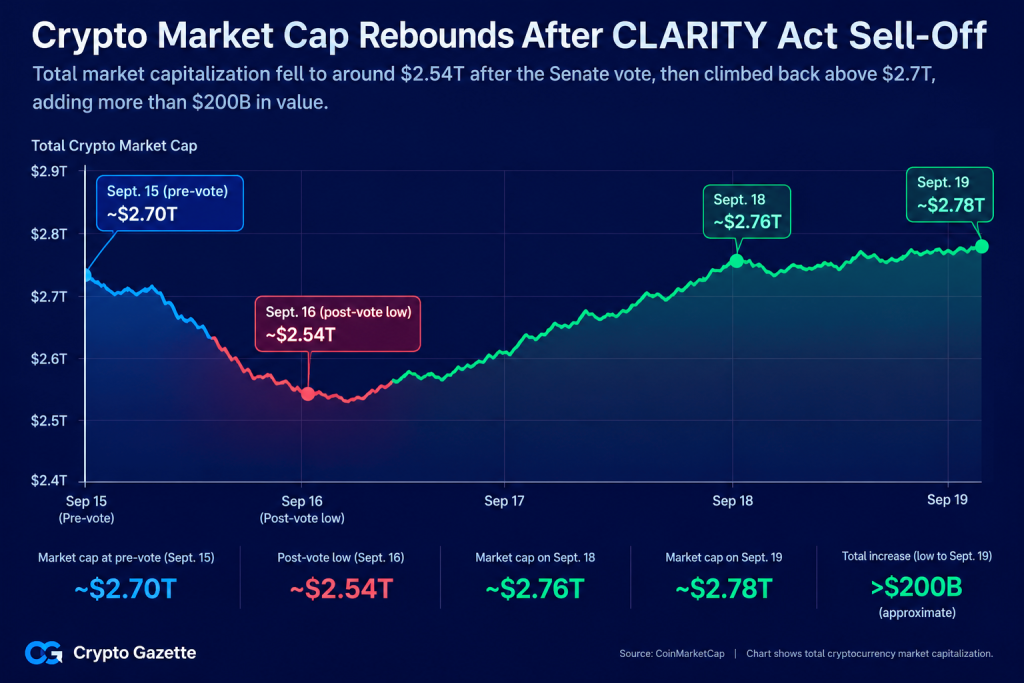
Crypto market capitalization recovered more than $200 billion from the post-CLARITY Act sell-off, rising from approximately $2.54 trillion on Sept. 16 to about $2.78 trillion by Sept. 19.
Several developments arrived as the market recovered. On September 17, the SEC announced an Innovation Exemption allowing qualifying Tokenized Securities Venues to facilitate limited onchain trading of certain tokenized U.S. stocks under temporary, conditional exemptions. The agency said the relief would expire five years after publication and imposed conditions covering trading volumes, investor rights, smart-contract auditability and transparency. The CFTC has also continued developing its crypto framework. Its public record shows a September 17 no-action position for providers of passive software, while reporting on September 18 said the agency had submitted a broader crypto-market rulemaking to the White House’s regulatory review process. The contents of that proposed rulemaking have not been publicly disclosed, so its eventual impact remains uncertain.
The recovery also occurred against a difficult macroeconomic backdrop. The Federal Reserve raised interest rates by 25 basis points on September 16, taking the federal funds target range to 3.75%-4%. Yet by September 18, Bitcoin had climbed back above $80,000, while assets including Solana and Hyperliquid posted substantial gains. The price action therefore shows a market that has so far absorbed the CLARITY Act setback rather than one that has ignored it: the legislation’s failure leaves the industry’s preferred statutory framework unresolved, while SEC and CFTC actions provide separate avenues for regulatory development. Whether those agency measures can eventually substitute for legislation is still an open question.
